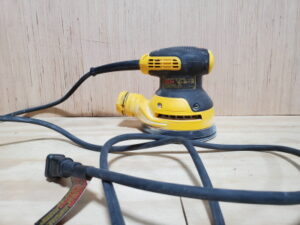
Random Orbital Sanders
The tech behind this type of sander was introduced commercially by Rupes Tools in 1968. According to their own website, “RUPES revolutionized the world of sanding by launching the first electric random orbital sander, BR 8 in 1968. To preserve the user’s safety, a dust removal system was integrated into all the RUPES sanders and in 1974 the first electric palm sander was introduced: The LE 7, a machine designed for single-handed operation.”
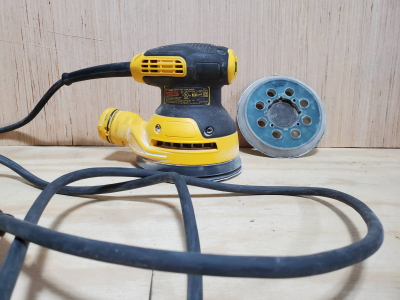
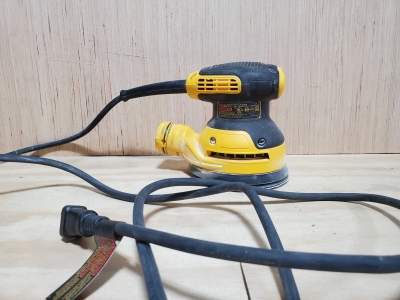
Many of the orbital sanders on the market today still follow the same designs as the BR8 but with up-to-date tech. As any woodworker knows dust mitigation can be a huge problem and potential fire hazard in any shop, shed, or garage. Our researcher for this article is a hobbyist epoxy woodworker and swears by his DeWalt corded random orbital sander (model DWE6420 – pictured). Some of the reasons he purchased the sander were 1) The power switch was designed in way to fully resist dust infiltration 2) It has ability be hooked up centralized collection system or shop vac.
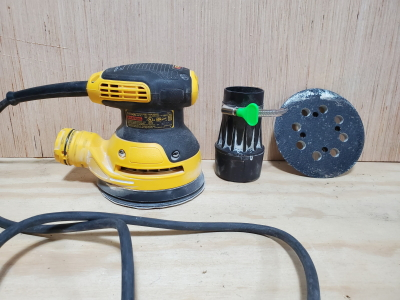
To attach the dust port to other vacuum systems with 1-1/4″ hoses, use model DWV9000 Universal Quick Connector. This quick connector can be added to your dust collection hose and left there. This will allow you to move from tool to tool in your workshop faster.
Additionally, the metal backplate can be interchanged. The tool initially uses adhesive-backed sandpaper but the backplate can be removed and replaced with a backplate that uses the hook and loop system (Velcro). Our researcher said the backplates for the adhesive-backed sandpaper would eventually get gunked up with the residual glue left behind from each sandpaper disc and that it would periodically require removal and thorough cleaning of the disc backplate with something like goo gone for instance. Also, the financial costs to change the backplate, roughly $12 when he did it a couple of years ago, outweighed the continual costs of buying goo gone and scraping tools. This also allowed him to also go from a 5-hole dust collection disc to an 8-hole dust collection system. The result was a tidier shop and less dust being tracked into his house.