
Belt Sanders
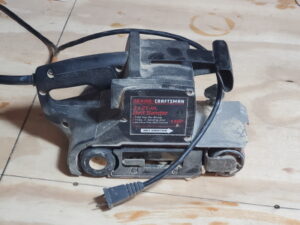
On a hand-held belt sander, the belt is wrapped around two cylinders and held in place via tension. When powered on the two cylinders will move in unison to drive the belt forward. Originally the technology to change the belt was and still is on some models a spring tension. You literally would have to stand the sander on end and push down on the front wheel until it locks into the release position then change the belt and once the new belt is on push down on the front wheel again to apply the tension. Now many of the newer models offer a tension lever that will release or apply the amount of tension needed to hold the belt on the sander. Users should always use the adjuster screw on the side of the sander to properly align the belt in the center position. It should also be noted that unless the belt is Omni-directional it will have indicators on the inside of the belt that show which way the belt should be installed. Improper installation and alignment will shorten the life of the belt.
Our research into belt sanders showed us that the typical width for a sander was 3 inches with the length of the belt usually being 21 inches. There are also widths of 2 and 4 inches and if you buy a small detail belt sander these can use a belt of 3/8”. We also noted that the lengths, depending on the model, can be as short as 18 inches and as long as 24 inches.
Benchtop belt sanders are designed to sit right on your workbench or a stand similar to a table saw. There are both vertical and horizontal benchtop belt sanders and usually, both models also feature a disc sander on the side of the machine. These semi-stationary tools are typically used by woodworkers who are preparing material for finished products. Belt sizes vary widely for benchtop sanders in both width and length. Although we touch on bench sanders here in this article in the near future we will be posting an article just about benchtop sanders for woodworking and metalworking.
We like to make our articles as robust and as informative as possible but admittedly this one could use some help. If you have any feedback on belt sanders we want to hear about it! Have you found one brand has more problems than another? Maybe you found one brand of belt that works better and gets less gunked up? Maybe you have some other feedback that we haven’t touched on. To submit your feedback you can fill out the form at the bottom of the page.